1. The Origin and Early History of Kohinoor Diamond
The Kohinoor Diamond is one of the most famous and mysterious diamonds in the world. It is not just a beautiful stone but also a symbol of power, war, history, and controversy. Many people believe that this diamond carries a curse, while others see it as a priceless treasure taken from India during colonial rule. The story of Kohinoor is long, emotional, and full of mystery. It connects India, Persia, Afghanistan, and Britain through centuries of history.
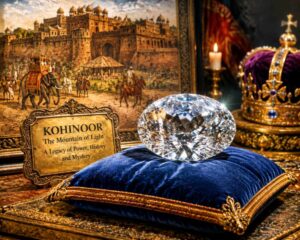
The name “Kohinoor” comes from the Persian language, which means “Mountain of Light.” This name shows how bright and valuable this diamond is. Today, the Kohinoor is part of the British Crown Jewels and is kept in the Tower of London. But its real journey started in India hundreds or maybe thousands of years ago.
The exact origin of the Kohinoor diamond is not clearly known. Some historians believe it was found in the famous Golconda mines in southern India. These mines were once the richest source of diamonds in the world. It is believed that Kohinoor was mined as early as the 13th century or even before that. From the beginning, it was not just a stone but a symbol of royal power.
The earliest recorded history of Kohinoor begins with the Kakatiya dynasty in India. It is believed that the diamond was installed in a temple of a goddess in Andhra Pradesh. According to some legends, it was placed on the forehead of the idol of the goddess Bhadrakali in Warangal. This shows that Kohinoor was considered sacred in its early history.
2. Kohinoor in Mughal Empire and Persian Invasion
Later, when rulers changed, the diamond passed into the hands of many kings. One of the most powerful rulers connected with Kohinoor was Alauddin Khilji. It is said that his generals brought the diamond after conquering southern India. From here, Kohinoor started its journey through many empires, wars, and betrayals.
After the Khilji dynasty, the diamond passed into the hands of the Mughal Empire. The Mughal emperors were known for their wealth and love for jewels. The Kohinoor became part of the Mughal treasure. The famous Mughal emperor Shah Jahan, who built the Taj Mahal, also admired this diamond. It is believed that the Kohinoor was once placed in the Peacock Throne, which was one of the most expensive thrones ever made in history.
The Peacock Throne itself was a symbol of unmatched wealth. It was decorated with many precious stones, and Kohinoor was one of its main highlights. During this time, the diamond was not just a jewel but also a political symbol showing the power of the Mughal Empire.
However, the Mughal Empire slowly started weakening. In 1739, Persian ruler Nadir Shah invaded India and defeated the Mughal emperor Muhammad Shah. Nadir Shah took away the Peacock Throne and many treasures, including the Kohinoor diamond. It is said that when he saw the diamond, he was so amazed that he named it Kohinoor, meaning “Mountain of Light.”
There is also a famous story related to Nadir Shah and the Kohinoor. According to legend, the diamond was hidden in the turban of the Mughal emperor. Nadir Shah discovered it only after a clever trick, where both kings exchanged turbans. This story is widely told, though historians are not fully sure if it is true or just a myth.
3. Journey of Kohinoor from Afghanistan to British Rule
After Nadir Shah, the diamond passed into Afghan rulers. After his death, his empire broke into pieces, and Kohinoor was taken by his generals and successors. One of the important rulers during this time was Ahmad Shah Durrani, founder of the Durrani Empire in Afghanistan. From Afghanistan, the diamond eventually reached Punjab in India.
In Punjab, the Kohinoor came into the possession of Maharaja Ranjit Singh, the powerful Sikh ruler. He ruled the Sikh Empire and was known as the “Lion of Punjab.” Under his rule, the Kohinoor was again a symbol of Indian strength and pride. Maharaja Ranjit Singh kept the diamond as part of his royal treasury and planned to donate it to the Jagannath Temple in Puri before his death.
But after Ranjit Singh died, the Sikh Empire weakened. The British East India Company took control of Punjab after the Anglo-Sikh wars. In 1849, the Treaty of Lahore was signed, and the Kohinoor was officially handed over to the British.
It is said that a young Maharaja Duleep Singh, the son of Ranjit Singh, was forced to give the diamond to the British. He was only a child at that time. This moment is often seen as one of the most controversial events in Indian history.
4. The Curse, Controversy and Modern Status of Kohinoor
After reaching Britain, the Kohinoor was presented to Queen Victoria. The diamond was later cut and polished again to improve its shine and appearance. Originally, it was much larger, but after cutting, its weight reduced significantly. The diamond was then set into different royal crowns over time.
Today, the Kohinoor is part of the British Crown Jewels and is kept in the Tower of London. It is mainly associated with Queen Elizabeth The Queen Mother’s crown, which is displayed in the Jewel House.
Now comes the most interesting part of the Kohinoor story—the curse. Many people believe that the Kohinoor diamond carries a curse. According to legend, whoever owns the Kohinoor will suffer misfortune unless it is possessed by a woman. Because of this belief, many male rulers in history who owned the diamond faced defeat, loss of power, or death.
For example, some stories say that Nadir Shah was assassinated after taking the diamond. Others say that the Sikh Empire fell after Maharaja Ranjit Singh’s death. However, there is no scientific proof of any curse. Most historians consider it a myth created over time.
Still, the idea of a curse adds mystery to the diamond and makes it even more famous worldwide. Whether true or not, people are always fascinated by this belief.
Another major controversy around Kohinoor is ownership. India, Pakistan, Afghanistan, and Iran have all claimed that the diamond should be returned. India especially has demanded its return many times, saying it was taken during colonial rule. However, the British government has refused to return it, saying it was legally handed over through treaties.
This debate continues even today. Many people see Kohinoor not just as a diamond but as a symbol of historical injustice. Others believe it is now part of British history and should remain where it is.
The Kohinoor is also unique because of its unmatched beauty and size. Even though it has been recut, it still remains one of the most famous diamonds in the world. Its story is more valuable than the stone itself.
If we look at modern times, Kohinoor is not used as a piece of jewelry worn daily. It is preserved as a historical artifact. Millions of tourists visit the Tower of London every year just to see it.
The mystery of Kohinoor also lies in its journey. Very few objects in the world have traveled through so many empires, kings, wars, and countries. From Indian temples to Mughal palaces, from Persian courts to British crowns, Kohinoor has seen it all.
In conclusion, the Kohinoor diamond is not just a stone but a living history. It represents power, beauty, greed, war, and cultural pride. Its story teaches us how valuable things can change hands through history and how they can carry emotions of entire civilizations.
Even today, the Kohinoor continues to shine—not just because of its physical light, but because of the endless stories, mysteries, and debates connected to it. Whether it is called a blessing or a curse, one thing is certain: Kohinoor will always remain one of the most legendary diamonds in human history.
Pingback: MH370 Mystery Explained in Detail | MH370 Mystery Full Story
Pingback: Vaishno Devi Temple 10 Mysteries and Story Explained – Faith, Journey and Divine Secrets of the Cave Temple - STORY AND MYSTERY