1. Life After Dinosaurs – The Day Earth Changed Forever
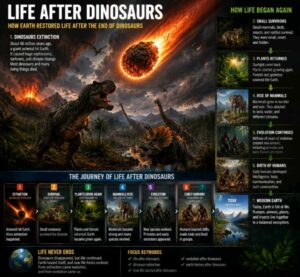
Life after dinosaurs began after one of the most powerful events in Earth history. About 66 million years ago, a huge asteroid hit Earth and caused massive destruction. This event is known as a global mass extinction because most living species died at that time. The sky became dark, temperatures changed suddenly, and food sources started disappearing. Large dinosaurs could not survive these extreme conditions, and they slowly went extinct.
But Earth was not completely empty. Small creatures like insects, tiny reptiles, and early mammals survived. These small survivors became the foundation of new life. Over time, Earth slowly recovered, and new ecosystems started forming. This was the beginning of a completely new chapter called life after dinosaurs, where mammals started to rise and dominate the planet.
2. Life After Dinosaurs – The Asteroid Impact and Earth’s Collapse
The main reason behind the end of dinosaurs was a massive asteroid impact that hit the region we now call Mexico. This event caused huge explosions, wildfires, earthquakes, and dust clouds that blocked sunlight for a long time. Plants stopped growing properly because sunlight could not reach Earth’s surface. Without plants, herbivores died, and then carnivores also disappeared.
This chain reaction destroyed most of the food chain. Oceans were also affected, and many marine species died. The planet entered a “dark phase” where survival became extremely difficult. This disaster completely reshaped Earth and created conditions for life after dinosaurs to begin in a new direction.
3. Life After Dinosaurs – Survival of Small Creatures
After the extinction event, only small and adaptable animals survived. These included early mammals, birds, insects, and reptiles. Small mammals were especially successful because they could hide underground, eat almost anything, and survive in harsh conditions.
Unlike dinosaurs, these animals did not need large amounts of food. This gave them a strong survival advantage. As the environment slowly became stable again, these small survivors began to spread across the Earth. This stage is very important in life after dinosaurs because it marks the beginning of mammal evolution and ecosystem rebuilding.
4. Life After Dinosaurs – The Return of Plants and Forests
As dust settled and sunlight returned, plants slowly started growing again. First came simple plants, then grasses, shrubs, and eventually large forests. This process took thousands of years, but it was essential for rebuilding life on Earth.
Plants are the base of all food chains, so their return allowed animals to grow and multiply again. Herbivores returned first, followed by predators. Forests became rich and green again, creating new habitats for evolving species. This natural recovery was the backbone of life after dinosaurs, helping Earth become stable once more.
5. Life After Dinosaurs – Rise of Mammals
After dinosaurs disappeared, mammals got the chance to expand and evolve rapidly. They were no longer small hidden creatures but started becoming larger and more diverse. Over millions of years, mammals evolved into many forms such as horses, elephants, whales, and primates.
This era is often called the “Age of Mammals” because mammals became the dominant animals on Earth. They adapted to land, water, and even air in some cases. This stage in life after dinosaurs shows how nature fills empty ecological spaces with new species when old ones disappear.
6. Life After Dinosaurs – Evolution of Complex Animals
As time passed, mammals and other surviving species continued to evolve. Some adapted to cold climates, others to hot environments. This natural selection process slowly created more advanced and specialized animals.
Primates, a group of mammals, started developing better intelligence and social behavior. Over millions of years, these primates evolved further, leading to early human ancestors. This part of life after dinosaurs is important because it shows how simple survival eventually leads to complex life forms through gradual evolution.
7. Life After Dinosaurs – Birth of Early Humans
Human evolution is one of the final stages of life after dinosaurs. From small primate ancestors, early humans gradually developed larger brains, better communication, and tool-making abilities. They learned to survive in different environments and formed early communities.
This development took millions of years. Humans were not sudden creations but the result of continuous evolution. Fire, tools, and cooperation helped early humans become the most advanced species on Earth. This marks a major milestone in life after dinosaurs, where intelligence became the key to survival.
8. Life After Dinosaurs – Modern Earth and Today’s Life
Today’s Earth is the result of millions of years of recovery and evolution after dinosaurs. Modern ecosystems include millions of species, from tiny bacteria to large animals like elephants and whales. Humans now dominate the planet, but we still share the Earth with countless other living beings.
Technology, science, and agriculture have made humans powerful, but the foundation of all life still comes from the recovery process after the dinosaur extinction. Life after dinosaurs teaches us that Earth can recover from even the worst disasters, and new life always finds a way to grow and evolve.